
01
Multi-Unit Analytics — a SQL case study in PostgreSQL + dbt
Multi-Unit Analytics — a SQL case study in PostgreSQL + dbt
The analytics I ran professionally, rebuilt in public: same-store sales, margin variance, and menu-mix analysis on a deliberately messy 9-location restaurant POS dataset (about 5M rows; synthetic by design, since real multi-location P&L data is proprietary everywhere). dbt models the all-TEXT raw feed into typed, tested marts; 67 automated data-quality checks run green in GitHub Actions CI on every push, and the seeded Python generator regenerates the dataset byte-identically.
Twelve business-question SQL analyses (window functions, gap-and-islands streaks, a POS-to-ledger tie-out, a recursive rollup) decompose a 4.2-point prime-cost overrun, roughly $127K a year, into a weekend labor template and a held vendor price pass-through; findings ship as a decision memo. The same dataset shows why naive growth reads lie: +10.2% naive vs +4.8% true comp growth.
On top sits a measured text-to-SQL evaluation: a 24-question ground-truth bank, frozen before the run, scored by execution match. The same model scores 23/24 on the modeled marts layer vs 18/24 on raw data; that gap is the measured value of the data modeling, published with a per-failure analysis.
PostgreSQL 16 · dbt-core · Python · GitHub Actions CI · seeded deterministic dataset · source, memo & eval results →
02
Triage — autonomous incident response on AWS
Triage — autonomous incident response on AWS
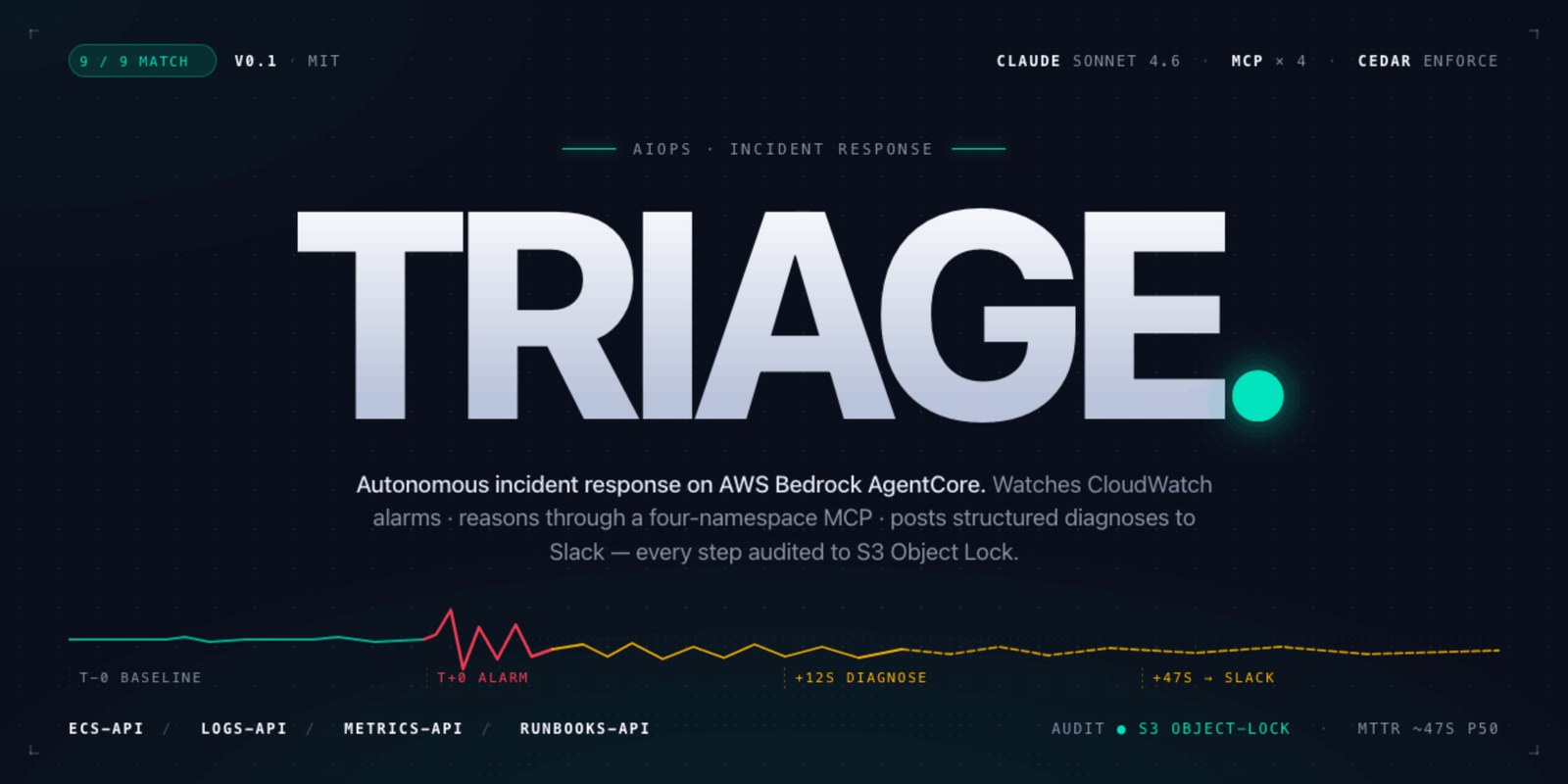
An AIOps agent on AWS Bedrock AgentCore: it watches CloudWatch alarms, investigates failures through a four-namespace custom MCP server (six tools), and posts structured diagnoses to Slack. Write actions pass through Cedar policies at the AgentCore Gateway — six active policies — and every reasoning step and tool call lands in an immutable S3 Object Lock audit journal.
Evaluated, not just demoed: a nine-scenario outage corpus — four AWS Fault Injection Service experiments and five deliberate Terraform misconfigurations — scored by AgentCore Evaluations with five built-in evaluators and three custom LLM-as-judge evaluators, including a MAST failure-taxonomy classifier. The most recent run of every scenario scores Match: 9 for 9, a bar reached through iteration — across 31 runs, the eval pipeline caught real bugs in both the infrastructure and the agent's reasoning.
Terraform 1.14 · Python 3.12 · custom MCP server · Cedar · OpenTelemetry · portfolio project, evaluated against a deliberate outage corpus · source & architecture →
03
Infrastructure
Infrastructure
Terraform multi-AZ VPC
A production-style VPC module: four subnets across two availability zones, internet gateway, multi-AZ NAT, custom route tables, and layered security groups — 18 resources per deployment, with remote state in S3 and DynamoDB locking. Validated with EC2 test instances exercising the public→internet, private→NAT, and bastion traffic paths.
CI/CD: GitHub Actions → ECR → ECS Fargate
An end-to-end pipeline: lint → test → build → push to ECR → deploy to ECS Fargate, authenticated via OIDC — no long-lived AWS keys in GitHub. Multi-stage Dockerfile with a non-root user and healthcheck-gated startup.
both in devops-learning · this site runs the same way: S3 + CloudFront, Terraform-provisioned, OIDC-deployed — source
04
Operations analytics at Il Mulino
Operations analytics at Il Mulino
As an operations analyst at Il Mulino, a New York restaurant group (2023–2025), I ran into a blunt data problem: every location named its dishes differently, so franchise-level, per-dish sales analysis was impossible. I built a Python pipeline (BeautifulSoup, Selenium, sentence-transformers, scikit-learn TF-IDF) that standardized the nomenclature across locations into a unified master sales sheet.
The legacy POS had no API — I prototyped GUI screen-mapping automation first, then pivoted to a separate ingestion-and-standardization pipeline. I presented the result to the CEO and the Director of Finance not as a standardization tool but as the franchise-wide per-dish sales picture they could now investigate — and they agreed to make the reports recurring. Alongside it: monthly reconciliation of multi-location Excel sales exports against POS records, with cleansing and validation before anything reached accounting.
the public companion piece: Multi-Unit Analytics rebuilds this class of analysis end to end on an open dataset
05
About
About
Based in New York, NY — open to relocation. BBA in Economics from Baruch College, CUNY (2023), with a minor in political science. Two years as an operations analyst in New York, then a self-directed 60-day sprint from Linux fundamentals through Terraform and CI/CD to the eval-driven Triage capstone.
Looking for data, analytics, operations, and cloud roles. Native English and Serbian. The fastest way to reach me is email.